Posts

Showing posts with the label Australia

Shark Bay, Western Australia

Image
  Shark Bay is a World Heritage Site in the Gascoyne region of Western Australia. One of the superlative natural phenomena present in this property is its stromatolites, which represent the oldest form of life on Earth and are comparable to living fossils. Shark Bay is also one of the few marine areas in the world dominated by carbonates not associated with reef-building corals. Source:  http://whc.unesco.org/en/list/578

Postcard from 1993, Australia

Image
This postcard is very rare for me as I have found it in Charity shop in local town. It was sent out ob 8th of March 1993 to Milan, Italy.  The card shows Curtain Fig Tree. The Curtain Fig Tree is one of the largest trees in Tropical North Queensland, Australia, and one of the best-known attractions on the Atherton Tableland.  It began life about 500 years ago when a bird, or possibly a small mammal, dropped the seed of a fig-tree in the crown of the host tree, over 20 metres above ground.

Tasmania

Image
Tasmania, an isolated island state off Australia’s south coast, is known for its vast, rugged wilderness areas, largely protected within parks and reserves.

Uluru

Image
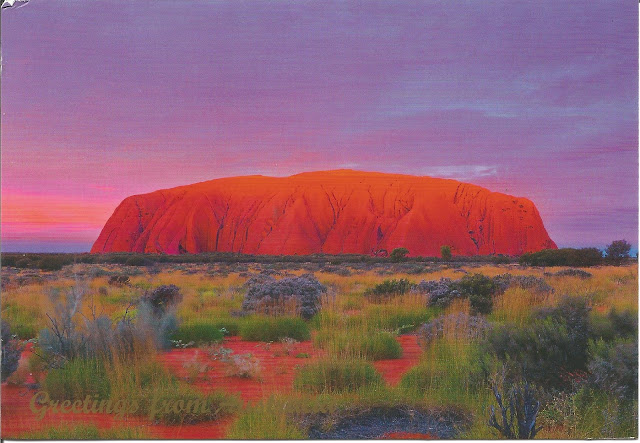
 Uluru is one of the most best-known landmarks in Australia.It is better known as Ayers Rock. The rock was created over some 600 million years, and the Aborigines have been in the area for the last 10,000 years.Ulu r u lies west of the Simpson Desert, not far from the ‘Red Centre’ of Australia.

The Rocks, Sydney

Image
The Rocks is an urban locality, tourist precinct and historic area of Sydney's city centre, in the state of New South Wales, Australia.  The Rocks is the oldest area of Sydney and has recently undergone an amazing metamorphosis, the old district being transformed into a vibrant pocket of cafes and restaurants and interesting tourist shops and stalls. This has been achieved without destroying the area's Old World charm and historic buildings. Sydney's town planners have put in place a sensitive conservation program that has preserved the heritage.

Map of Australia

Image
Explore Map of Australia: Officially known as the Commonwealth of Australia, it is a country in the South Hemisphere comprising the mainland of the Australian continent, the island of Tasmania, and numerous smaller islands in the Indian and Pacific Oceans. Australia is the 6th largest country in the world by total area. Recently, I have noticed that Australian map has dog and cat faces on it: Everything in my life changed when I realised that.

Kangaroo

Image
Kangaroos are the largest marsupial surviving on earth today. They are well known for their style of movement; hopping on their hind legs whilst using their large, muscular tail for balance. Kangaroos use their tail like an extra leg when they are manoeuvring around, or standing still. Kangaroos are one of the only animals that are not able to move backwards easily, and this is why they are used on the Australian national emblem.

Koala

Image
   Koalas do not drink much water and they get most of their moisture from leaves. In Aborigine language, the word ‘koala’ means ‘no water’.    Baby Koalas are known as ‘ Joeys'. When the Joey is born, it’s only about 2 centimetres long , is blind and furless and its ears are not yet developed. On its amazing journey to the pouch, it relies on its well-developed senses of smell and touch, its strong forelimbs and claws, and an inborn sense of direction. Once in the pouch, it attaches itself to one of the two teats which swells in its mouth, preventing it from being dislodged from its source of food.

Sydney Harbour Bridge

Image
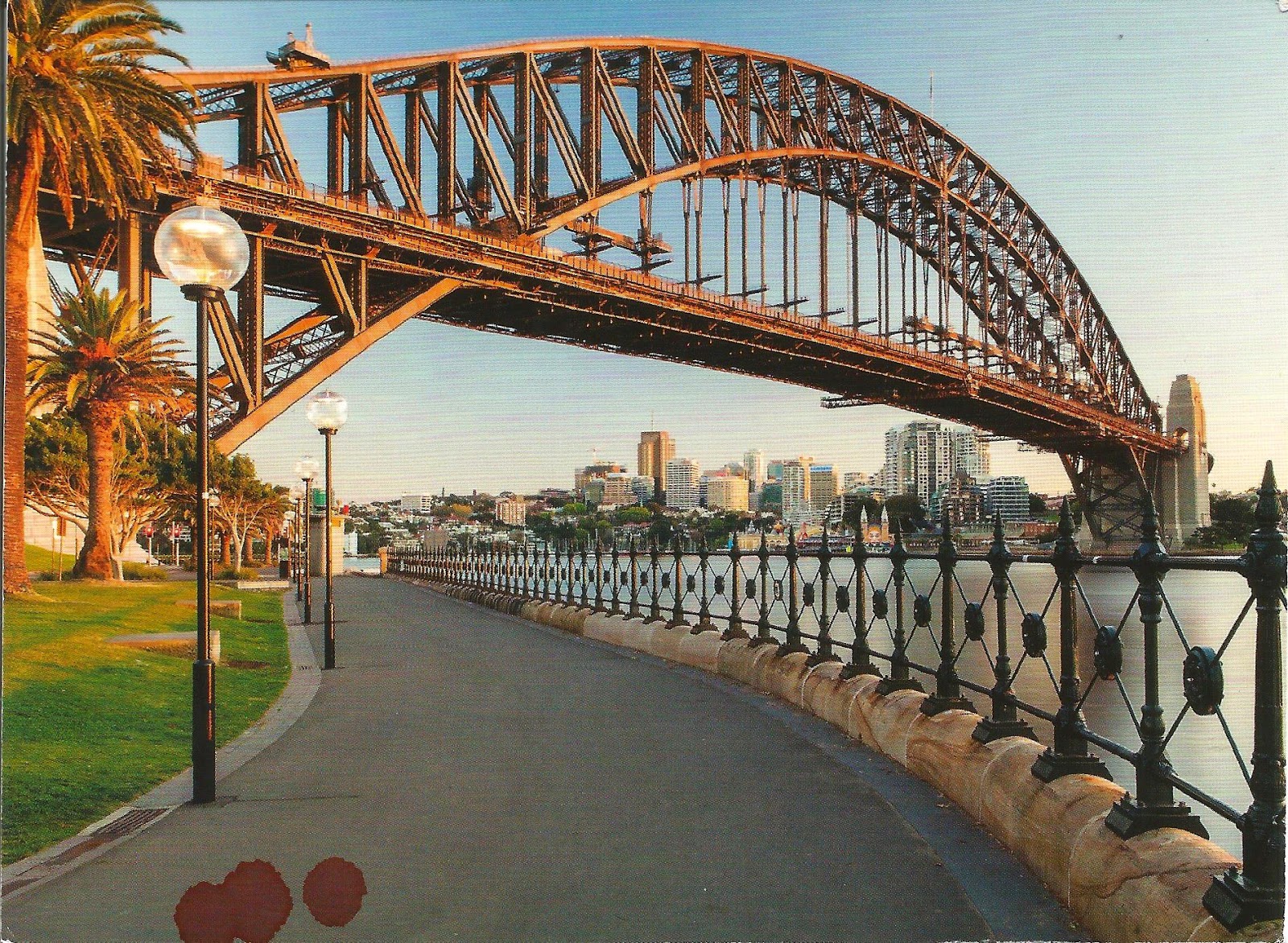
Standing proudly above Sydney Harbour, the Sydney Harbour Bridge is one of the architectural jewels in the crown of Australia's most beautiful city.  Instantly recognisable, the Sydney Harbour Bridge is the world's tallest steel arch bridge. It connects the northern suburbs of Sydney with the city centre, making it a vital link in Sydney's transport infrastructure; more than 200,000 cars travel across the bridge in a single day.

Byron Bay

Image
 This postcard came to me from New South Wales in Australia. Interesting fact is that now I live in South Wales in UK.   The history of Europeans in Byron Bay began in 1770, when Lieutenant James Cook found a safe anchorage and named Cape Byron after John Byron. In the 1880s, when Europeans settled more permanently, streets were named for other English writers and philosophers

Sydney Opera House

Image
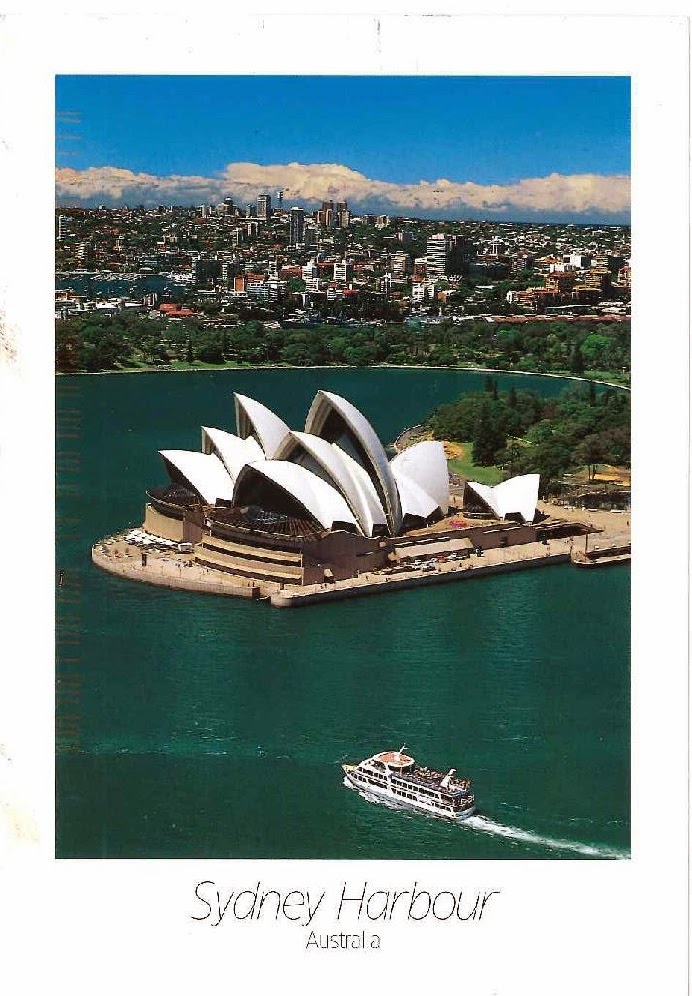
 Inaugurated in 1973, the Sydney Opera House is a great architectural work of the 20th century that brings together multiple strands of creativity and innovation in both architectural form and structural design. A great urban sculpture set in a remarkable waterscape, at the tip of a peninsula projecting into Sydney Harbour, the building has had an enduring influence on architecture. The Sydney Opera House comprises three groups of interlocking vaulted ‘shells’ which roof two main performance halls and a restaurant. These shell-structures are set upon a vast platform and are surrounded by terrace areas that function as pedestrian concourses. In 1957, when the project of the Sydney Opera House was awarded by an international jury to Danish architect Jørn Utzon, it marked a radically new approach to construction.